A friend of mine recently commented that if he scored a quarter note with a marcato accent at the start of a piece, and then a note at the end with an accented staccato, the effect might very well sound the same; as would possibly a single quarter note with no marking whatsoever in the middle (in the same dynamic context). This musing was added to a recent thread in the Orchestration Online group, in which many opinions on the topic were shared, from concert and jazz players, and some conductors as well. Reading that thread, one might come away with the notion that the marcato accent is so subjective as to appear meaningless in today’s scoring. At least to the players, who I’m sure prove my friend’s observation true in his work, the marking might mean anything, even when the composer has a specific intention – especially if the context hasn’t been made clear.

The honest truth is that we composers only have ourselves to blame for this – and that the way forward for the marcato accent, if it’s to be used effectively, is for us to both clarify and differentiate its use from other markings. As I hope to illustrate in this chapter, this can be done quite simply with the correct contexts. And those contexts are: tempo; technique; character; and force.
Orchestration manuals have many different ways of describing the effect; and these are of course dependent on style and period no less than its ambiguous usage by composers since the Classical period. So here’s my description, upon which I hope we can build some kind of common-sense consensus to help guide our players with intelligence and artistry.
An accent is an emphasised attack. A marcato at forte-to-fortissimo is a punch in the face. How do we punch? Using the full arm, analogous to a string player using a big length of bow, but not in a smooth tenuto way – rather, very swiftly, digging in savagely. For a wind or brass player, the effect is also a punch; of full breath behind a powerful attack. In either case, the enormous force which is applied results in a shorter note – as the string player will have used most of their bow length within the span of a single beat, usually. With winds and brass, the character of articulation also defines the note as more abrupt. I feel that with a truly effective forte marcato, the shortness is not necessarily the point, but more of an outcome. The orchestrator should be aware that a string player’s bow arm isn’t infinite in length, nor is the capacity of the wind and brass players’ lungs. The more direct and emphatic the intention and execution, the more effective and individual the result.

Such force as is usually understood to be applied has a direct effect on strings, in that the bow remains on the string, and not leaping off and then back on, as with spiccato/saltando. If we dig into the definition of the word “marcato” as meaning that every such note is “well-marked,” then it isn’t only the attack and the speed of the bow which articulates the tone – but also the cutoff of each note by a deliberate stopping of motion. This stopping of the bow is another kind of accent in itself, which can further underline a character of curtness, not to mention aggression – and as the winds and brass will attempt to match the exact articulation of the strings, their approach will likewise involve a deliberate cutoff.
There’s a speed limit to such walloping and blasting from your players, especially in a string passage marked “martellato” or “martelé” – essentially “hammering” – in which a series of marcato notes are executed, often of the same duration in sequence. Gevaert in his 1885 Nouveau traité d’instrumentation felt that this limit was 16th-notes at ♩=100 – and there’s still some truth to this in today’s world of aggressive string marcato in film scoring. Pushed above a certain tempo, the proper forte marcato articulation starts to lose its shape, becoming more of a staccato or staccatissimo. And indeed, martellato passages in the repertoire are often marked with staccato dots or staccatissimo teardrops, rather than a string of “hats.”

There’s another limitation to the efficacy of such scoring – and that is the reserves of strength and endurance of the players. A piece that’s all forte marcato for many many long minutes will use up your musicians (especially the embouchure of your wind and brass players), possible exhausting their usefulness for the rest of the concert or recording session. Even a shorter passage or movement may cause the same problems, if its severe complexity results in a number of retakes or more rehearsal time to get right. If you’re a developing composer with such a score, don’t feel slighted if the players therefore rehearse at half-strength in order to save their lips or bow arms.
So in the sense that a forte marcato accent has a very direct, forceful attack; and that it has a specific kind of cutoff of its own; then I would say that if the orchestrator has set up their musical passage in a way that amplifies these qualities, then there will be a difference between such a note compared to a staccato accent. A staccato accent might be quite short by intention, and even leap off the string; while a marcato accent should dig in with a fury and end rather savagely. As to the unadorned quarter note in the middle of a loud passage; that will sound however the passage sounds – but a true marcato note will call attention to itself, and in a sense may define the impact of a certain point in the passage.
Notice, though, my qualification of the word “forte” – as in “forte marcato accent.” Of course, the focus of this chapter is almost entirely on the use of the marking forcefully, as that’s the general thrust of its application in concert and film scoring. But the composers and musicians who invented the marking had a more general conception than such a high-stress definition. Looking at early Romantic works, we see some composers applying marcato as a broader kind of accent, more fully-inhabited than quickly spent. In Schumann’s Rhenish Symphony, for instance, the marcato dotted half notes in a piano crescendo passage are usually played in a rather squishy way – with a gentler dig, a fuller shape, and a gentle defining cutoff setting up the next such note. This sets up a persistent yet not too aggressive emphasis on the downbeat of each bar.

All of my above pronouncements and examples are what might occur in a perfect world. But we should be aware that a marcato marking means “whatever the conductor thinks it means,” as the old joke goes. And that’s no slam on your poor overworked conductor. Rather, it’s an observation that someone has to parse all the different definitions and intentions behind the marcato accent, and make a decision that will serve the most effective performance of the music considering a horde of often unkind variables. These include underpowered sections (especially in the viola department); acoustic response of the hall (and the difference between it being full capacity or sparsely attended); the culture and interpretation of the players and between the sections (including some orchestras that default to a more connected, tenuto inflection); and of course the genre of the music and tendencies of the composers in question. Three different pieces on the programme may result in three different recommendations for playing marcato. For instance, in the jazz-influenced opener, the winds and brass might be pushed into playing very biting, super-punchy accents when they see the marking; as would be appropriate to that style. A work with a more cinematic character might be interpreted according to my recommendations above; and yet the closer, a Mahler symphony, might treat marcato as merely a kind of biting emphasis at the start of a longer tone, as likely to appear in softer dynamics as loud ones.

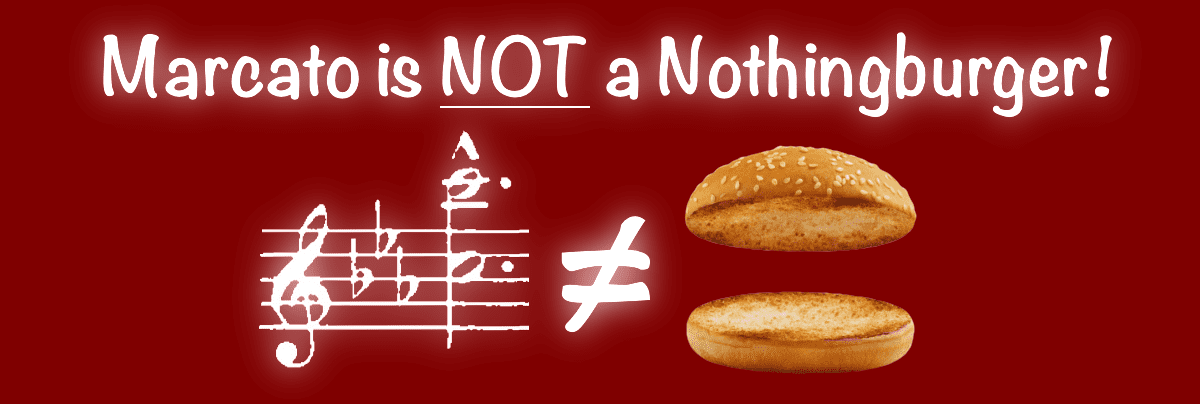
And this is why I must insist that the marcato accent is not a nothingburger. Even its apparent nebulosity still connotes very specific categories of interpretations – which the performers and conductor must be aware of in context of style, period, and composer idiosyncrasies. My recommendation for today’s orchestrators, though, is to use the most commonly-accepted markings to convey certain approaches, and to save the marcato accent for the specific effect of the most accented, forceful playing possible. At least with that strategy, there will never be any mistake on the part of the player about what you intend; and the marking will stand out in ways that justify its existence.