
Harmonic double-stops are possible on string instruments; but they require some care from the orchestrator in setting up for the players, not to mention justification for their existence in section scoring.
(This version of the tip focuses on violin as an exemplar for double-stopped natural string harmonics. The final version for the book will discuss all members of the string section, with a complete set of charts.)
There are several weighty problems in approaching the topic of harmonic double-stops on strings; the first of which being whether they are ever really necessary in string section scoring. As harmonics are by their nature more of a delicate effect best applied at a softer dynamic level, and should be carefully scored within a greater texture if any, then it would of course be much easier to have any two harmonic pitches played divisi between two players on each desk. That way, the two notes in question might be any available pitches that could be produced artificially or naturally. But with double-stopping, with the exception of Paganini-level solo playing, natural harmonics are really the only practical pitches I should recommend scoring.
Even accepting just the limited array of natural pitches, we next have to consider whether the orchestrator has cultivated the necessary experience to assign two adjacent pitches that will make any sense considering the realities of finger positions. And even when this is taken into account, the question will naturally arise whether one of the pitches will speak as well as the other. This concern is of such weight that I’d say it’s the strongest argument for simply abandoning the whole idea and going back to divisi, at least if we’re scoring for section strings.
Then there’s the whole question of how to score such pitches in a quickly readable, intelligible way for both the conductor and the players. Fortunately, this very issue was addressed by such composers as Ravel over a century ago; but few orchestration manuals have bothered to explain the approach used even for single pitches.
This tip aims to answer all the questions above, and provide a meaningful, universal understanding of the technique and how to express it simply and logically for the players. What I’ll suggest is by no means the only strategy in all situations; as many harmonic tones are available in multiple positions across different strings – but at least this tip will provide some kind of starting point of orchestrators who simply cannot resist or avoid such scoring in their own works.
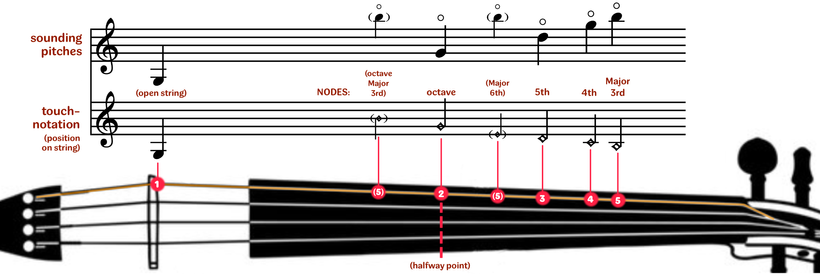
A simple review of the position of natural harmonic nodes and their relevant pitches clears up a lot of questions. The strongest sounding and easiest-to-negotiate nodes are positioned in a logical sequence backward from the centre of the string’s length; which follow the harmonic series step-by-step. Starting with the violin’s 4th string, the open pitch of G3 represents the fundamental; the octave node in the middle of the string sounding an octave higher as the second partial on G4; the node at the 5th sounding a perfect 5th above that as the third partial on D5; followed by the node at the 4th sounding up a perfect 4th from there as the fourth partial on G5, a full two octaves above the open string. This touch-4 harmonic is the configuration used in almost all artificial harmonics, with a lower finger stopping the pitch two octaves below the intended sound, and a higher finger touching the new node of a perfect 4th above the stopped pitch. One additional node may possibly be used in some combinations, though it’s more feasible for solo or chamber playing than justifiable in section scoring: the node at the major 3rd sounding two octaves-plus-a-major-3rd above the open string, in this case the pitch of B5. This 5th partial has alternate positions, the ones most useful for our purpose being the nodes on E4 and B4.
The diagram below illustrates this quite plainly. The number 1 represents the full length of the violin’s open G string; then 2 represents the octave node, 3 the node at the 5th, and so on. Notice that the harmonics are notated both in their intended pitches with a circle above, andin a kind of touch-notation. The player, reading the latter notes and understanding them to be played on the 4th string, sul G, will know exactly where to apply their fingers.
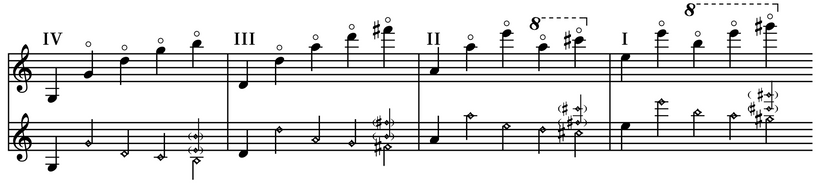
Keep in mind that touch-notation won’t properly activate the correct tones in your notation app playback, so you may need some work-arounds (such as invisible notes) in order to produce an accurate mockup.
Following the illustration above, we’re left with an array of 16 pitches which might be combined; 20 if you include open strings in double-stops with harmonics. You’ll notice an upward tendency toward pitches in sharp keys, in conjunction with the tone of each open string – G, D, A, and E. It goes without saying that the scoring of our planned harmonic double-stops will be most useful in those tonal landscapes.
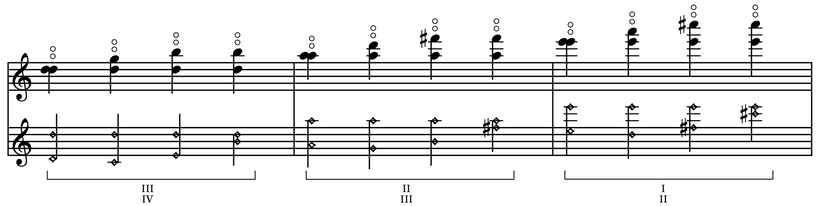
The simplest combinations are playing any two adjacent harmonics in perfect 5ths – in other words, in the same position on neighbouring strings, and touch a single fingertip across both strings. The perfect balance between the strength of the harmonics represents an added benefit. Notice that I’ve added indications below the notes of the strings to be used. These aren’t always necessary – but they do help to quickly clarify the exact string to be used, which is helpful on short rehearsal and preparation time. When there are two possible ways to play a certain combination, such as with the A5th in the 1st and 2nd bars below, always default to the lowest harmonic positions for the greatest projection and clarity (unless the higher harmonics are more conveniently adjacent to an ongoing finger position).
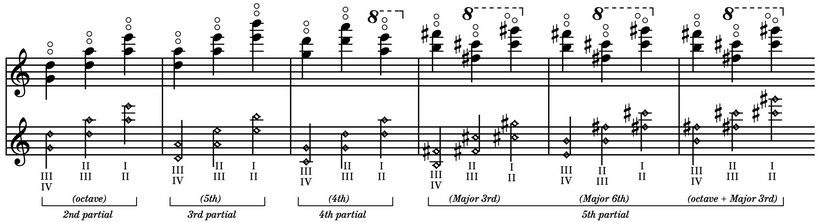
To keep this systematic, let’s chart the possible combinations in sequence from the lower to higher positions of the lower notes of each interval. And in consideration of this, remember some basic guides to double-stop fingering. Firstly, that it’s easier to position the higher finger on the higher string. Second, that the fingers shouldn’t stretch any further apart in distance than the span of a 5th on the fingerboard (which should be even shorter with viola and cello). Applying these principles to combinations in which the higher string is playing the octave node, and the lower string touching higher nodes, then we can see that adding the nodes at the 5th and 4th work very well – but the 3rd is too far to stretch. Here’s where the alternate 5th-partial nodes will work better; but be aware that the imbalance between the powerful octave node and the delicate 5th partial nodes will be less than ideal. Another important point is that the combination at the 5th produces a unison, which violinists often play in the process of tuning.
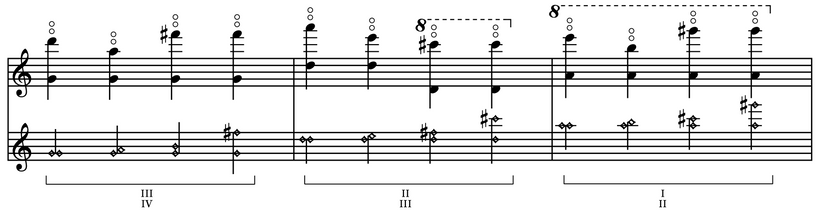
Reversing the equation is not the most successful strategy. The octave node, when played on the lower string, will tend to dominate much more, and be of a far greater distance in perceived pitch. It’s also less comfortable and natural to the player, and some combinations may take a little longer to set up under the fingers.
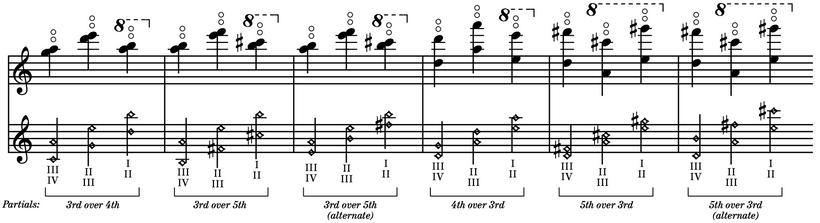
Our last batch of combinations all involve the 3rd, 4th, and 5th partials – and since these are more discreet and closer-spaced than previous, they will tend to balance better. Their subtlety and delicacy are at a premium, so I recommend using them sparingly, and even perhaps consulting with section players before trotting these out if it’s your first time scoring them. The success of harmonic scoring often relies on conditions of technique, the flow of the overall passage for the player, and the architecture of the texture. So proceed with caution.
The 4th and 5th partials positioned on the lower adjacent string to the 3rd partial produce intervals of major 2nds; while the reverse results in octaves and major 10ths. This last combination is as subtle as subtle can be.
One last technique worth discussing is arpeggiando bowing across triple- and quadruple-stopped natural harmonics. Perhaps the most striking example of this was scored by Ravel in Soupir from his 3 Poèmes de Mallarmé. The entire string quartet bows patterns across quadruple-stops in a dreamlike beating of wings. In the violin part, which I’ve excerpted below, I’ve added an ossia of reference pitches above. The position here only requires 3 fingers, with the 3rd (ring) finger stopping a perfect 5th across the 5th partials of the highest two strings. These two pitches are repeated at the end as a double stop, as seen in the 3rd bar of Ex. 3 above.