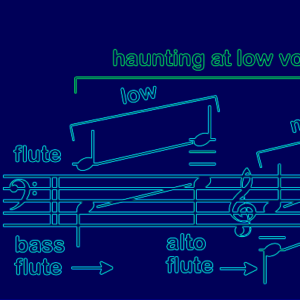
Woodwind Octaves, Part 2: Relationships Within Families.

Woodwind Octaves, Part 2: Relationships Within Families.

(Tip no. 4 from 100 MORE Orchestration Tips, to be released in March 2020) Exposed woodwind octaves using members of the same families of instruments can be very effective, so long as the registers are balanced in dynamics and timbre. In my lecture at Azusa University earlier this year, I shared a tip regarding exposed…
Read more…
Orchestration Tip: Divisi vs. Double Stops

Orchestration Tip: Divisi vs. Double Stops

(Tip no. 81 from 100 MORE Orchestration Tips, to be released in 2020) Don’t assume that you always need to score double-stops instead of divisi in order to balance strings against other sections. A common challenge for developing orchestrators is deciding when to score divisi and when to score double stops (“non divisi”). It’s not…
Read more…

Orchestration Tip: Second Wind Player’s Roles

Orchestration Tip: Second Wind Player’s Roles

(Tip no. 2 from 100 MORE Orchestration Tips, to be released in 2020) Give the solo part to the first player in most cases, whether high or low; and think of the second players’ roles as being supportive in the best way, rather than ignominious. “To what degree should second wind players should be given…
Read more…

Orchestration Tip: Saxophone Tonal Similarities and Blending, Part 2

Orchestration Tip: Saxophone Tonal Similarities and Blending, Part 2

(Tip no. 24 from 100 MORE Orchestration Tips, to be released in 2020.) Similarities of timbre mentioned in the previous tip can provide a guide to the saxophone’s use in soloing, substitution, and textural blending. Despite similarities between saxophones and concert instrument counterparts, it’s important to underline that resemblances are not replications! No matter what…
Read more…

Saxophone Tonal Similarities and Blending, Part 1

Saxophone Tonal Similarities and Blending, Part 1

The similarities of timbre between saxophone models and orchestral winds and brass should be well-known to the orchestrator. When saxophones made their initial orchestral appearances in the late 19th/early 20th centuries, it was for their uniqueness of timbre, introducing what would have been an exotic sound into the standard ranks of the wind section. Despite…
Read more…

Orchestration Tip: The Case of the Disappearing Flute

Orchestration Tip: The Case of the Disappearing Flute

(Tip no. 06 from 100 MORE Orchestration Tips, to be released in 2020.) The resonance of violins tends to absorb the sound of a flute an octave higher. This effect can be used to enhance the timbre of the violins. Once upon a time there was a young orchestrator who scored an exposed first flute line…
Read more…

Orchestration Tip: Viola use of treble clef

Orchestration Tip: Viola use of treble clef

(Tip no. 94 from 100 MORE Orchestration Tips, to be released in 2019) The pro concert violist’s capacity to read ledger lines is usually greater than a developing orchestrator supposes. Frequently changing to treble staff because of a few ledger lines isn’t helpful to the player. Another frequently-asked question is at what point should a…
Read more…

Horn Section Teamwork

Horn Section Teamwork

(Tip no. 39 from 100 MORE Orchestration Tips, to be released in 2018) Default to horns 1 and 2 as much as possible when only a pair is needed. In Tip 35 of 100 Orchestration Tips, “Horn Part Scoring Order,” (also available here on the website) I’ve touched on all the reasons why scoring horns…
Read more…

2018 Orchestration Challenge: Bartók (Closed)

2018 Orchestration Challenge: Bartók (Closed)

This event has now been closed. This Orchestration Challenge ran from 15 July through to 19 August, 2018. The entries of the following participants have been archived in the playlist embedded above: Website Subscriber Entrants: A – Arne Bremer, Erio Daja, George Owen, Jeremy Cullen, & Jerry Engelbach B – Jorge Isaac Merla Hernandez, Juan…
Read more…

Suspended Cymbal vs. Hand Cymbals

Suspended Cymbal vs. Hand Cymbals

(Tip no. 63 from 100 MORE Orchestration Tips, to be released in 2018) Sometimes composers treat the choice between suspended cymbal and hand cymbals as an arbitrary one, as if either might be used in the same situation. Or even more confusingly, the technique assigned to one actually would be better on the other. But…
Read more…